TMS Therapy For PTSD

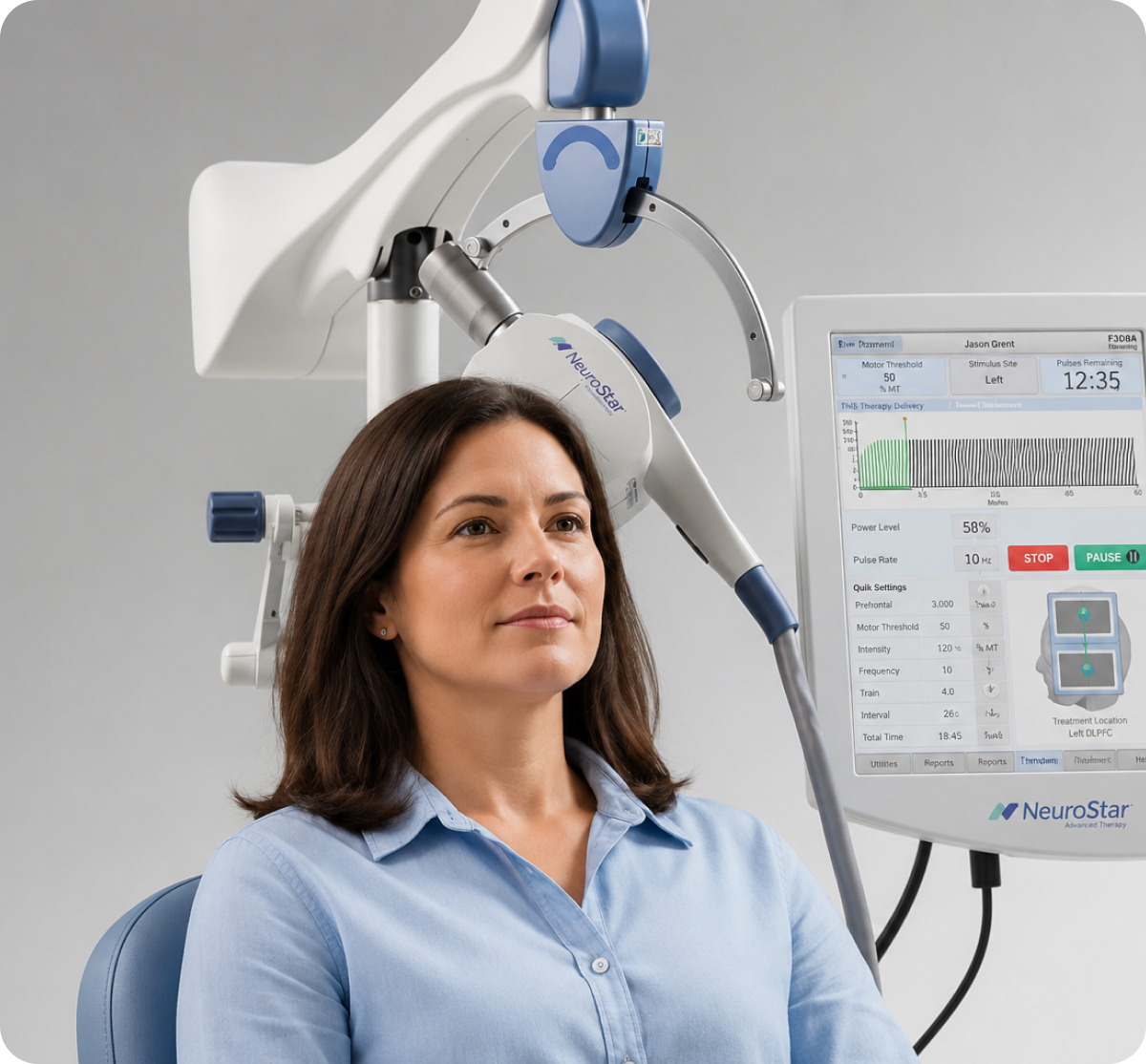
When therapy and medication still do not quiet the nightmares, flashbacks, and hypervigilance, TMS therapy for PTSD may offer another path. It uses targeted magnetic pulses to stimulate brain circuits involved in fear, mood, and stress regulation when the trauma response remains stuck.

63-78%

of patients with PTSD show meaningful symptom improvement with TMS across multiple clinical protocols

47-49%

achieve remission (PCL-5 score below 33) after a full treatment course

20-30 sessions

over 4-6 weeks, 19-37 minutes per session

Evidence-supported off-label

for PTSD (not yet FDA-cleared, but strong clinical data exists)

Is TMS Therapy the Right Next Step for Your PTSD?

You may have already tried first-line PTSD care: trauma-focused therapy such as EMDR, prolonged exposure, or CPT, and/or medications like SSRIs or prazosin for nightmares. 

Here’s the important distinction: NeuroStar TMS is NOT FDA-cleared for PTSD as a primary indication. The official NeuroStar Prescribing Information explicitly lists PTSD as a population where safety and effectiveness have not been established in a controlled clinical trial. This means TMS for PTSD is used off-label, though there is growing clinical evidence supporting its use.

The strongest evidence exists for patients with PTSD plus co-occurring depression. A large 2025 multisite VA study of 756 veterans found that TMS produced substantial PTSD symptom reductions across all protocols studied. TMS works best for people with treatment-resistant symptoms who haven’t fully responded to standard care.

Patients with certain conditions are not eligible for NeuroStar TMS according to the official prescribing information:

History of seizure or epilepsy

Metal implants in or around the head (including aneurysm coils, cochlear implants, deep brain stimulation devices)

Cardiac pacemakers or implantable defibrillators

Psychotic disorders including bipolar mania or schizophrenia

Active substance abuse

You may have already tried first-line PTSD care: trauma-focused therapy such as EMDR, prolonged exposure, or CPT, and/or medications like SSRIs or prazosin for nightmares.

Learn more about TMS Therapy

PTSD Symptoms: How TMS Therapy May Help Reduce Them

PTSD is not a weakness. It’s a brain circuit disorder. After trauma, your threat detection system gets stuck in overdrive. Here’s what patients actually describe:

Symptom Domain

Re-experiencing

Hyperarousal

Avoidance

Negative mood

Insomnia

Irritability

Hypervigilance

Dissociation

Concentration problems

Common Impact

Flashbacks that feel like it’s happening now. Intrusive images. Nightmares that replay the trauma. Your brain won’t let it go

Always on edge. Scanning rooms for exits. Startling at loud noises. Can’t relax even when you’re safe

You stop driving that route. Don’t go to crowded places. Push away anyone who might ask questions. Your world gets smaller

Numb. Guilty. Like the best part of you died in the trauma. Nothing feels good or worth doing

Can’t fall asleep because your brain won’t shut off. Wake up at 3 AM in a cold sweat. Dread bedtime

Snapping at people you love. Road rage. Feeling like anger is the only thing you can still feel

Constantly watching. Listening. Waiting. Your nervous system treats every neutral event as a potential threat

Feeling disconnected from your body. Like you’re watching yourself from outside. Time gets weird

Can’t follow conversations. Forget what you were saying mid-sentence. Brain fog that won’t lift

TMS Therapy for PTSD: How It Works in the Brain

PTSD changes your brain. The prefrontal cortex, your brain’s “CEO”, becomes underactive. It can’t properly regulate the amygdala, your fear center, which becomes hyperactive. Result: your threat response gets stuck on.

TMS targets this imbalance.
A magnetic coil sits against your scalp, delivering focused, MRI-strength pulses to specific brain regions. For PTSD, the most studied protocols include:

  • 10 Hz left prefrontal stimulation The standard depression protocol, which also shows PTSD symptom reduction
  • Intermittent TBS (iTBS) A shorter patterned protocol that achieves similar effects in less time
  • Deep TMS (dTMS) Uses a specialized H-coil that reaches broader brain networks

The 2025 multisite VA study compared these three protocols in 756 veterans with PTSD and depression. All three produced substantial symptom reductions, 18 to 22 points on the PCL-5 (PTSD checklist). Importantly, the shorter iTBS and dTMS protocols were noninferior to the standard 10 Hz protocol, meaning they worked just as well.

Think of it like this: your trauma circuit is a car alarm that won’t turn off. TMS doesn’t rip out the alarm. It helps your brain regain the ability to turn it off when there’s no real threat.

TMS does not work through the bloodstream. That means no medication-like weight gain, sexual dysfunction, or drowsiness. No sedation. No recovery time. You can drive yourself home after treatment.

Here’s how TMS stacks up against the alternatives for PTSD:

Feature

Works by

FDA status

Response rate (PTSD)

Systemic side effects

Targets all PTSD clusters?

Anesthesia required

TMS Therapy (off-label)

Magnetic pulses rebalancing prefrontal-limbic circuits

Off-label for PTSD; cleared for MDD

63-78%

None

Yes, all four clusters improve

No

SSRIs (Sertraline, Paroxetine)

Increasing serotonin availability

FDA-approved for PTSD

40-60% (partial response common)

Weight gain, sexual dysfunction, emotional blunting

Partial

No

Trauma-Focused Therapy

Re-processing trauma memories, extinction learning

Evidence-based, not regulated

50-70% (high dropout)

None (but therapy is hard work)

Yes

No

Prazosin

Blocking norepinephrine to reduce nightmares

Off-label for nightmares

Nightmares only

Dizziness, low blood pressure, fatigue

No, nightmares only

No

Why TMS over additional SSRIs for treatment-resistant PTSD:

If you’ve tried one or two SSRIs without enough relief, another SSRI is unlikely to be the answer. TMS offers a completely different mechanism targeting brain circuits directly.

Why TMS alongside trauma-focused therapy:

Many patients find therapy exposures overwhelming because their baseline hyperarousal is too high. TMS can lower that baseline, making it possible to actually do the therapeutic work.

Why TMS over prazosin:

Prazosin only targets nightmares, not daytime symptoms. TMS addresses all four PTSD symptom clusters simultaneously.

Learn How TMS Therapy Works

TMS Therapy for PTSD: What to Expect During Treatment

PTSD protocols at FitMind follow the evidence-based parameters from clinical research. Here’s what a typical course looks like:

Step 1:

Free TMS Education

You meet with patient coordinator Valeria Alana to discuss your trauma history, current symptoms (nightmares? flashbacks? hypervigilance? avoidance?), and what treatments you’ve tried.

Step 2:

Psychiatric Evaluation

Dr. Sarah Boaz or Victoria Kozel, DNP confirms PTSD diagnosis, screens for contraindications (seizure history, metal implants, bipolar disorder, substance abuse), and determines if TMS is appropriate.

Step 3:

Motor threshold mapping.

About 90 minutes. The TMS treater finds the exact pulse strength needed for your brain. Your first visit takes about 90 minutes total. This includes:

  • Clinical setup and motor threshold mapping (~20-30 minutes) to find the exact pulse strength needed for your brain.
  • Your first full TMS treatment session.

Step 4:

Daily Sessions

Most PTSD protocols run 4-6 weeks, 5 days per week, 20-30 total sessions. Each session lasts 19-37 minutes. You sit in a recliner, awake the whole time. The coil makes a clicking sound. You feel tapping on your scalp. For PTSD, clinicians typically use left prefrontal protocols (10 Hz or iTBS) based on the VA study showing effectiveness.

Step 5 :

Return to Normal Activity 

TMS does not require sedation or recovery time. Most patients return to work, school, or normal routines right after the session. 
A note on timing: The VA study measured outcomes after a full course of treatment (20-30 sessions). Some patients notice changes in sleep or startle response within the first 1-2 weeks. The greatest improvement often happens as you complete the full course.

One thing to know: TMS does not erase trauma memories. It reduces their emotional grip, the urgency, the physical reaction, the hijacking of your attention.

Contact Us For Free TMS Consultation

TMS Therapy for PTSD: Clinical Evidence and Safety Data

2025 Multisite VA Study (756 veterans): The largest real-world study of TMS for PTSD to date. Researchers analyzed clinical outcomes from veterans with comorbid PTSD and depression treated across multiple VA sites. Protocols included 10 Hz left prefrontal (n=526), iTBS (n=71), and deep TMS (n=61).

Key findings :

  • Substantial PTSD symptom reductions: 18-22 points on the PCL-5 across all protocols
  • Response rates (≥10-point reduction): 63% (10 Hz), 65% (iTBS), 78% (dTMS)
  • Remission rates (PCL-5 <33): 47% (10 Hz), 48% (iTBS), 49% (dTMS)
  • iTBS and dTMS were noninferior to 10 Hz (all p < 0.05)
  • Depression outcomes showed similar improvement patterns

2025 Systematic Review (94 studies, 39 on TMS):

A 2025 systematic review of interventional psychiatry treatments for PTSD found TMS response rates ranging from 12.5% to 80% across randomized controlled trials. The wide range reflects differences in patient populations, protocols, trauma history, and comorbidities. The review also noted that while TMS may improve PTSD symptoms, sustained efficacy varies, so maintenance strategies may be needed. Most treatments were well tolerated, with only mild, transient adverse effects reported.

Important limitations:

The systematic review notes that while TMS shows symptom improvement, sustained efficacy varies, underscoring the need for maintenance strategies. Most treatments were well tolerated with only mild, transient adverse effects.

Safety data (NeuroStar official sources) :

  • No deaths or seizures reported in NeuroStar clinical studies
  • Most common adverse events: application site pain (35.8% active vs 3.8% sham) and headache (~50% equally in active and sham)
  • Both side effects were transient (during the first week) and mild to moderate in severity
  • Seizure risk: <0.1% per patient.
  • No systemic side effects: TMS does not cause weight gain, sexual dysfunction, nausea, dry mouth, fatigue, or drowsiness

What this means for you:

These findings come from a large VA study of 756 veterans with PTSD and depression. TMS is not a guaranteed cure, but many patients had meaningful symptom reduction after a full course. For treatment-resistant PTSD symptoms, it may be a practical option to discuss when standard care has not been enough.

TMS Therapy for PTSD: Insurance Coverage and How to Get Started

Important coverage note: Because TMS for PTSD is off-label (not yet FDA-cleared), coverage varies significantly by insurance plan. However, most patients seeking TMS for PTSD have co-occurring treatment-resistant depression, which is FDA-cleared for NeuroStar. Coverage typically flows through the depression diagnosis.

NeuroStar is FDA-cleared for:

Major Depressive Disorder (adults)

As an adjunct for adults with OCD

Anxious depression (decreasing anxiety symptoms in MDD patients)

First-line adjunct for MDD in adolescents aged 15-21

FitMind accepts:

Aetna

Blue Cross Blue Shield (BCBS)

Cigna

Humana

UnitedHealthcare

Medicare

TRICARE (covers TMS for depression in adolescents 15+ and adults)

FitMind handles all prior authorizations. For PTSD specifically, we work with your insurance to establish medical necessity based on your full clinical picture (typically the co-occurring treatment-resistant depression diagnosis).
What you’ll need: Documentation of PTSD diagnosis and evidence that you have tried first-line treatments (trauma-focused therapy and/or SSRIs). A referral from your psychiatrist or therapist is helpful.

Schedule your free insurance check

Frequently Asked Questions

Is TMS therapy for PTSD FDA-approved?

No. TMS therapy for PTSD is currently considered off-label. NeuroStar is FDA-cleared for major depressive disorder, OCD as an adjunct treatment, anxious depression symptoms in MDD, and as an adjunct treatment for adolescents with MDD, but not specifically for PTSD.

That does not mean TMS for post traumatic stress disorder has no evidence. It means PTSD is not yet an FDA-cleared indication, even though clinical research, including a large VA study of veterans with PTSD and depression, suggests TMS may reduce PTSD symptom severity in some patients. 

TMS may be considered when PTSD symptoms remain after first-line treatments such as trauma-focused therapy, SSRIs, or medication management. This is often described as TMS for treatment-resistant PTSD, especially when trauma symptoms overlap with depression, anxiety, sleep disruption, or emotional numbness.

The goal is not to replace psychotherapy or erase trauma memories. TMS as adjunctive PTSD treatment may help reduce baseline hyperarousal, mood symptoms, and stress reactivity so patients can function better and tolerate trauma-focused work more effectively.

The 2025 multisite VA study compared 10 Hz left prefrontal TMS, intermittent theta burst stimulation, and deep TMS in 756 veterans with PTSD and depression. All three protocols were linked with meaningful PTSD symptom reduction, and iTBS and dTMS were noninferior to standard 10 Hz treatment. 

That means protocol choice may depend less on “which one is best” and more on the patient’s symptoms, treatment history, clinic equipment, session length, and clinician judgment. A TMS provider for PTSD should explain why a specific protocol is being recommended.

TMS for complex PTSD is still an emerging area, and most studies do not separate complex PTSD from other PTSD presentations. However, because complex and chronic PTSD often involve emotional regulation problems, hyperarousal, avoidance, trauma-related depression, and threat sensitivity, TMS may be considered when symptoms remain persistent despite standard care.

The most accurate way to say this is: TMS may help reduce some symptom clusters that often appear in complex PTSD, but it should not be framed as a standalone cure. Patients with long-term trauma histories usually still need a broader treatment plan that may include therapy, medication, sleep care, and support for relationships or daily functioning.

TMS for PTSD symptoms may help reduce re-experiencing, hyperarousal, negative mood, and avoidance symptoms by targeting brain circuits involved in threat detection and emotional regulation. In PTSD, these symptoms can show up as flashbacks, startle response, insomnia, irritability, emotional shutdown, or feeling constantly unsafe.

For nightmares specifically, TMS is different from prazosin. Prazosin mainly targets trauma-related nightmares, while TMS may have broader effects across daytime and nighttime PTSD symptoms. Still, results vary, and patients with severe nightmares may need sleep-focused treatment alongside TMS.

TMS for veteran PTSD and combat PTSD has been studied in VA settings, including a large multisite cohort of veterans with both PTSD and depression. The VA study found that 10 Hz TMS, iTBS, and deep TMS had comparable clinical effectiveness in this population. 

Safety screening is still important. Patients with seizure history, certain implanted metal devices, severe or repetitive head trauma, unstable substance use, or complex neurological histories need careful evaluation before starting magnetic pulse therapy for PTSD.

Yes. TMS treatment for trauma is often used alongside trauma-focused therapy rather than instead of it. Many patients struggle with EMDR, CPT, or exposure-based work because their nervous system is already too activated before the session begins.

By reducing hyperarousal, anxiety, and trauma-related depression, TMS may make therapy feel more tolerable. This is why many clinicians think of TMS as a brain stimulation support that can help patients engage more fully in the psychological work of trauma recovery.

TMS PTSD outcomes vary by study, protocol, patient population, and whether PTSD occurs with depression. A 2025 systematic review found TMS response rates ranging from 12.5% to 80% across randomized controlled trials, showing that results can differ widely. 

In the 2025 VA study, response rates ranged from 63% to 78%, and remission rates were close to 50% across protocols. These are encouraging results, but they should not be presented as guaranteed outcomes for every PTSD patient. 

TMS PTSD side effects are usually local and temporary. NeuroStar safety information lists scalp discomfort or pain at the treatment site and headache as the most common side effects, often improving after the first week. Seizure is a rare but known risk. 

Because TMS is noninvasive and does not work through the bloodstream, it does not typically cause medication-like side effects such as weight gain, sexual dysfunction, nausea, dry mouth, fatigue, or drowsiness. It also does not require anesthesia or recovery time after each session.

No. Transcranial magnetic stimulation for PTSD does not erase trauma memories. It is not memory deletion, hypnosis, or sedation. You still remember what happened.

The goal is to reduce the emotional and physical grip of those memories. In practical terms, that may mean fewer body-level threat reactions, less emotional hijacking, better sleep, improved concentration, and more ability to stay present when trauma reminders appear.

Next Steps

If PTSD still affects your sleep, mood, focus, and sense of safety after therapy or medication, TMS may be worth discussing. It is an off-label, non-invasive brain stimulation option supported by growing PTSD research, including a large 2025 VA study of 756 veterans. 


Call or text (904) 893-3265 to schedule your free consultation. Same-week appointments are often available.


📍 13241 Bartram Park Blvd Ste 613, Jacksonville, FL 32258

Schedule Your Free TMS Education

Insurances We Accept

Find Your Path to Wellness With Advanced TMS Sessions in Jacksonville

Depression can make it difficult to enjoy the things you love in life, but there is hope for a better future. If your depression symptoms have not responded to your attempts at treatment, NeuroStar Advanced TMS Therapy in Jacksonville may be a good fit for you.

Our providers at FitMind Therapeutics are here to help. Schedule a consultation with our team today to determine whether TMS is the next step in your treatment plan.

Please include the following minimal patient information: first/last name, DOB, address, contact number/email, diagnosis, insurance and policy number, and name of referring provider.

Insurance Coverage Notice

 TMS therapy is typically covered by most major insurance plans for the treatment of Major Depressive Disorder (MDD). If you're unsure whether your insurance covers your treatment, please contact us, and we'll be happy to verify your benefits on your behalf. For conditions that are not covered by insurance, we'll work with you to discuss alternative treatment and payment options.